
call it rain
I have the honor of presenting edd ravn in his first New York solo show, “call it rain”. If you ask edd, he will tell you he feels he has little to do with the creation of these paintings. What he indexes here is a relationship to material which sees something as transitional rather than static: how paper weathers; how seawater corrodes; how eggshells harden, soften, crumble, and breathe; how pigment changes and ages in mutating natural light; how microorganisms search across surfaces. edd wants to get out of the way of the materials, situating himself in the ecology and history of place, communing with the land and its spirits, listening all the while, so that he may be an attentive collaborator. It is sometimes hard to talk about edd and his paintings because both the paintings and edd are indebted to a capacious activity that goes beyond a studio practice. Both rupture the usual way I tend to think about art making or works of art. The pink shed exposed to the elements in Arkansas, where edd paints, is just one of the places where the energy these paintings conjure emerges. The practice that saw these pieces come to be extends beyond any studio space and into an active relationship with matter and the land. Rituals enter here. Lived ritual is an important part of edd’s life, from growing up on farms where he saw life cycles up close, during lambing season, to his own practices of folk magic, poetry, animism, and biodynamic farming. Rituals blur distinctions between human and non-human, life and death, past, present, and future. Important listening happens in the woods, in rivers, during ceremony, and is then released in the studio.
edd’s paintings extend from the land they were composed in. Colored by pigments announced from the earth, water from the rain, snow, rivers, and lakes, and binders of nori and casein made at home, the resulting watercolors register transformation, a kind of phase change, which happens before the viewers and after them. What these colors do across paper, hemp, and linen is multiple. Lines constitute a live edge in many of these pieces, like “eleos,” where colors pool and bristle while their edges fray into one another. Up close you can get lost in the canals; take a step back and a body extends horizontally across the freckled background. “shadow paradise” also shows itself in its edges, where solid color and shape fan out into a topography of translucent color. I still haven’t put my finger on what the resulting negative space does, but something is at work. Sometimes, the line is a crease, as in “estranged from beauty,” where the painted shape intercepts the order of the folds. Shadow symmetries are created, faint ghost afterlives resulting from a time when everything was packed together and left to mingle. There is evidence here of a mirrored scheme and also of the work’s lived past as a painting which has been weathered and made by more than just hands. The shapes that cohere operate around the symmetry rather than because of it.
The paintings in “call it rain” are a capacious offering. They are not just alive; they want to live, and speak, and can call on a myriad of syntaxis and symbols to do so. Because of this, they contribute something other than representation and abstraction—something more relational, something less permanent. Against a backdrop of a nutrient rich ashen walls, the paintings talk for themselves to those who will listen. The ash comes from restaurants in NYC, a kind of city detritus, the leftovers from an ancient cooking process that feeds New Yorkers. We are very excited to invite you to TW Fine Art at NADA in the third week of May to see what you might hear.
-Lucas Martínez
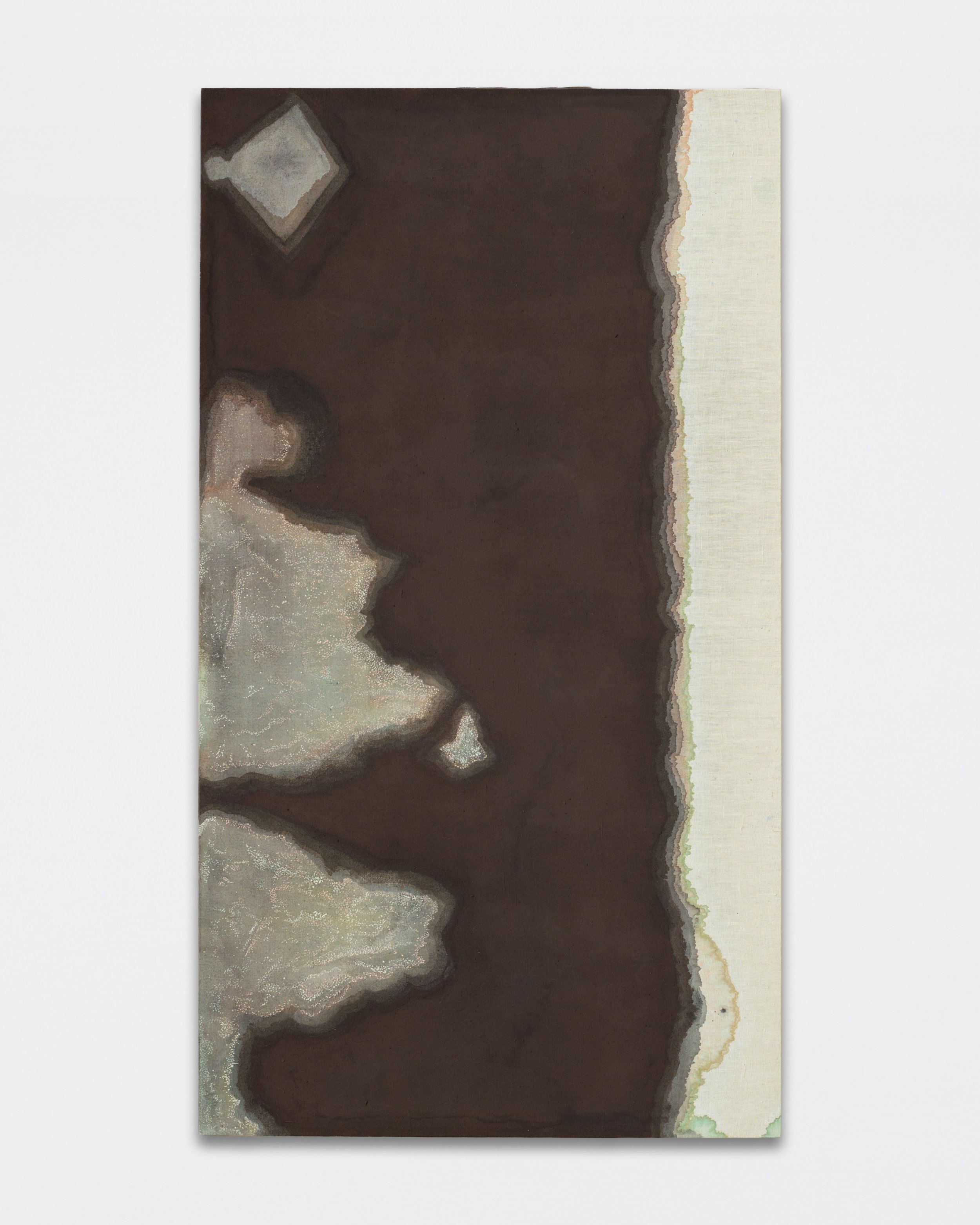
edd ravn
shadow paradise, 2026
rainwater, green earth, burnt umber, iron oxides, venetiian, sea salt, bone black, eggshell, nori paste on hemp
54 × 30 in.

